
La Porte Past Resident Sources
The backward trail changes with the era. Current parcel data gives the starting owner and legal description. Recorded instruments supply legal transfers. Historical directories and newspapers can place a household at an address, while plats and Sanborn maps test whether the same building or lot existed. No one source is a complete list of previous residents.
| Source | Years it covers | Where held | What it shows |
|---|---|---|---|
| Recorded deeds | Images stated from January 1966; separate county description reaches January 1832 | Recorder, Tapestry, Laredo | Grantor, grantee, instrument, book/page, legal description |
| City directories | Earliest La Porte volume 1859; substantial run through current | Historical Society Research Library | Dated names, addresses, and printed household facts |
| Newspapers and obituaries | Microfilm back to the late 1800s; local obituary files mostly mid-1930s forward | LPCPL and Historical Society | Events, relatives, moves, deaths, and address clues |
| Maps, atlases, plats | City maps from 1854, 1866, 1889; atlases and later plat books | Historical Society, LPCPL, State Library | Lots, blocks, streets, structures, and land divisions |
| Census material | Local indexes for 1840, 1860, 1870, 1880 and a 1850 abstraction | Historical Society and established archives | Households within the enumeration geography |
Start with the newest reliable source and work back one transfer or one publication year at a time. Note an absence as “not found in the run checked,” not proof that no one lived there.
Reverse La Porte County Deeds
The La Porte County Recorder holds the legal chain. Begin with the current assessment name in Beacon, but use the deed itself to confirm title. In Tapestry, search Grantor, Grantee, Parcel, and Address separately. A seller is the grantor. A buyer is the grantee. Once the latest purchase deed is found, the seller’s earlier purchase often identifies the next step back.
- Record the current parcel ID, legal description, and assessment name.
- Find the newest purchase instrument; copy its number, date, type, and book/page.
- Search the grantor as an earlier grantee, using the same parcel or legal description.
- Repeat, checking estates, trusts, middle initials, and entity names when printed.
- For material beyond reliable online coverage, ask the Recorder for the index, deed book, image, or certified copy.
The official coverage descriptions conflict. County material states real-estate images from January 1966, while another description says deed images begin in January 1832. Do not silently merge those claims. The Recorder counter, phone, and email can establish whether an old item is an index entry, an image, or a separate series.
- Grantor and grantee
- The party transferring an interest and the party receiving it.
- Chain of title
- The sequence of recorded transfers tied to the same land.
- Legal description
- The lot, block, subdivision, tract, or survey language that identifies land more steadily than a street number.
La Porte Tax Deeds Add Years
FamilySearch catalog 615671 identifies La Porte County tax-deed records from 1863 through 1923. The Recorder is named as author, and the catalog lists two microfilm reels with indexes, films 1685667 and 1685668, plus digital group numbers. This is not the full ordinary deed chain. It is a separate tax-deed series that can explain one kind of transfer.
Search the catalog online, then use a FamilySearch affiliate terminal at a La Porte County Public Library location if access is restricted. The Indiana Room can help distinguish catalog metadata from an available image. For an original or certified land record, return to the Recorder. Keep a tax deed, a present tax-sale notice, a normal conveyance, and an assessment card in separate columns.
La Porte Directories Date Households
The Historical Society’s Fern Eddy Schultz Research Library holds a La Porte city-directory run beginning in 1859 and continuing substantially to the present. Search the exact street as printed in each likely edition. Copy the year, page, spelling, number, resident name, and only the occupation or household notation actually shown. Telephone directories form a separate shelf and may help in later periods.
This is the key insider tip for previous residents: search the directory before assuming the current parcel number existed. If a number or street varies, compare the address with the legal description, an atlas, and a deed date. The full holdings and reading method belong to the La Porte city directory collections; for house history, use each volume as one dated point in an address chain.
The research library at 2405 Indiana Avenue is open for private research Tuesday through Saturday, 10:30 a.m. to 4:00 p.m., within museum access. Staff assist visitors and correspondents but do not promise in-depth research. Send the current and former street variants, target years, parcel description, and known book/page before asking for a folder.
Map Earlier La Porte Buildings
A past resident cannot be tied to a structure until the address is matched to the right lot and time. The Historical Society holds reproduction city maps for 1854, 1866, and 1889; indexed atlases from 1874 and 1892; atlases from 1907 and 1921; a long run of plat books; and Sanborn fire-insurance maps. Sanborn sheets can show a building footprint and use, while plats emphasize lots, blocks, and subdivisions.
The Indiana State Library LaPorte map catalog provides an authoritative access point.
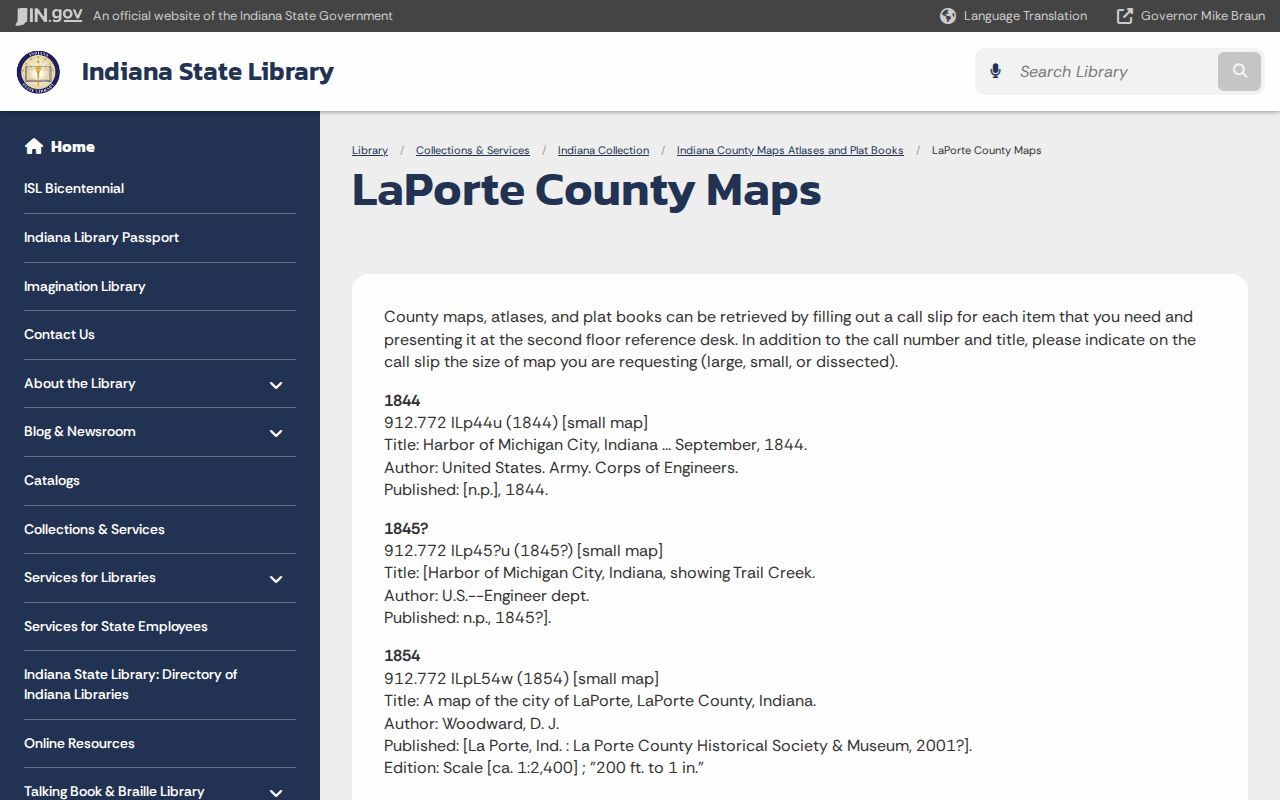
Use the catalog to identify the item, then confirm whether access is digital, on site, or through another holding library.
Pair La Porte Years Carefully
Directories and census schedules can complement one another, but their clocks differ. A directory is a publication snapshot. A federal census records an enumeration at a set time and uses the geography in force then. County boundaries, townships, and city lines changed, so a person associated with a modern La Porte address may appear under a township or nearby place.
A practical process keeps the dates visible:
- Check the closest directory edition before and after the census year.
- Copy the exact street entry and all documented name variants.
- Search the census within the correct enumeration place, then inspect the image and neighboring households.
- Compare the lot or block on a dated plat or Sanborn sheet.
- Use a deed, newspaper, probate file, or vital record to test the identity where lawful.
The Historical Society has an 1850 abstraction and indexes for 1840, 1860, 1870, and 1880. Federal census release follows the 72-year rule. An index is a finding aid, so inspect the image when the spelling or household structure matters.
La Porte Newspapers Close Gaps
LPCPL’s Indiana Room provides digital microfilm machines for regional newspapers back to the late 1800s. The Historical Society’s obituary file covers the La Porte Herald-Argus mostly from the mid-1930s forward, with an index from 1989 to current, and Michigan City News-Dispatch material from 1992 forward. Search La Porte and LaPorte, initials, surname variants, the street without its direction, business names, and a narrow year range.
An obituary may connect relatives, a prior community, a cemetery, or probate. A sale notice can date a transfer. A building story may explain use without naming a household. Record publication, date, page, and whether the item is an OCR result or viewed image. Newspapers can contain errors, so corroborate the address with a directory, deed, or map.
La Porte History Holdings Branch Out
The Historical Society’s collections extend beyond directories. House, building, business, industry, doctor, and hospital files may identify a property’s public use. School records and yearbooks, church minutes, cemetery maps, veteran cards, family histories, and wills can connect a named person to a dated local setting. Those clues are strongest when the request begins with an exact year or address variant.
The Indiana State Library county research guide catalogs historical court, marriage, divorce, naturalization, will, newspaper, map, and directory holdings.
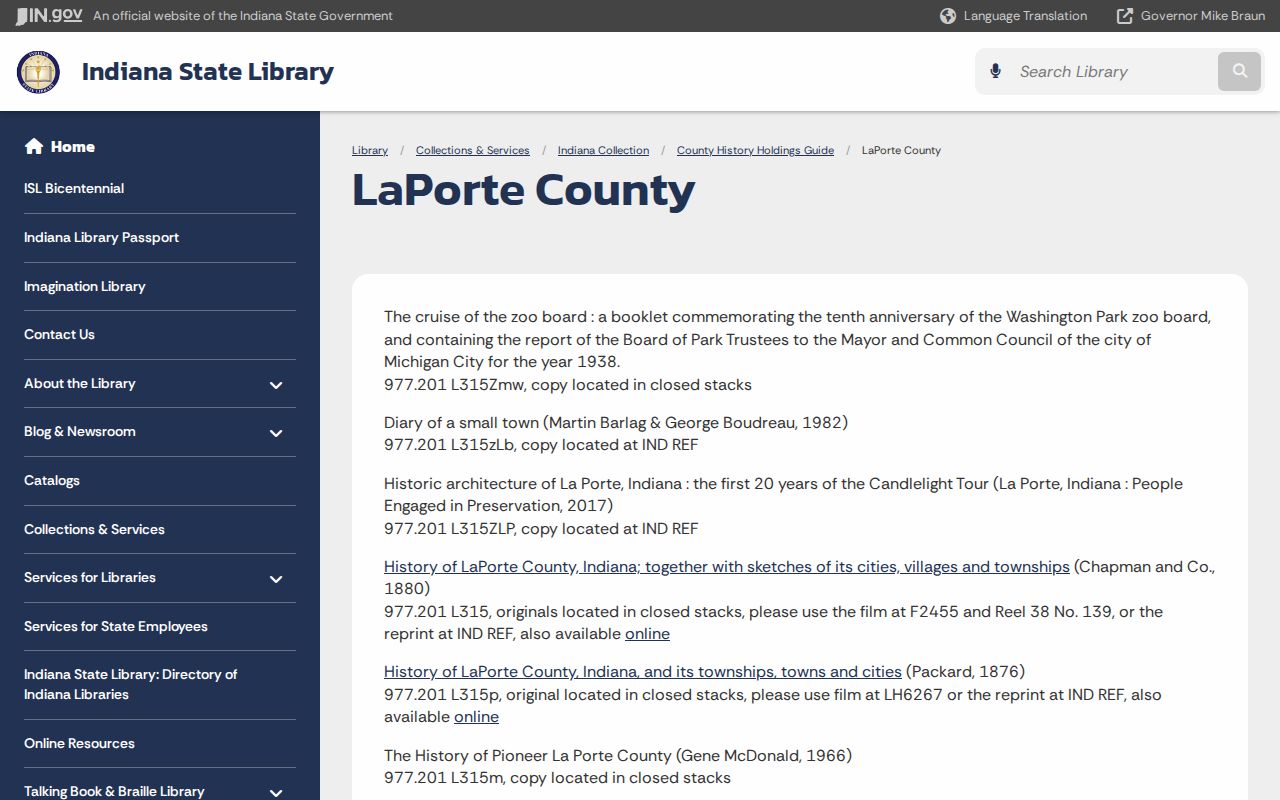
The guide points toward original custodians and historical series, which helps avoid treating a catalog mention as the underlying record.
La Porte Street Changes Stay Open
The modern city-numbering rules are known, but an official historic renumbering date or complete crosswalk was not found. Never interpolate an old number from today’s 50-foot progression. Ask City Engineering for archived assignment cards, maps, alphabetical street lists, and any old-to-new schedule. Indiana’s Access to Public Records Act can support a request that describes the desired record with reasonable particularity.
Compare a target block against the 1854, 1866, 1889, and 1921 maps, then test the number in the 1859 and later directories. Rail baselines, lot divisions, annexation, road shifts, and demolished structures can all cause two records to appear inconsistent. Preserve both forms until a dated municipal or archival source resolves them.
La Porte Previous Residents Need Proof
Past owners are only part of the household trail. A directory, census image, obituary, school item, or church record can supply occupancy or family context, while probate may identify estate parties and heirs. Birth and death certificates remain subject to direct-interest, identification, and age rules. Sealed or protected court records and confidential addresses must stay closed.
Write the conclusion in the record’s own terms: “listed in the directory,” “named as grantee,” or “shown in the census household.” Do not convert a mailing address, index hit, or same-name obituary into proof of residence. If sources conflict, note all dates and say what remains unresolved.
Lawful use. Research La Porte previous residents for house history, genealogy, and personal curiosity, never to track, harass, threaten, or harm a living person.